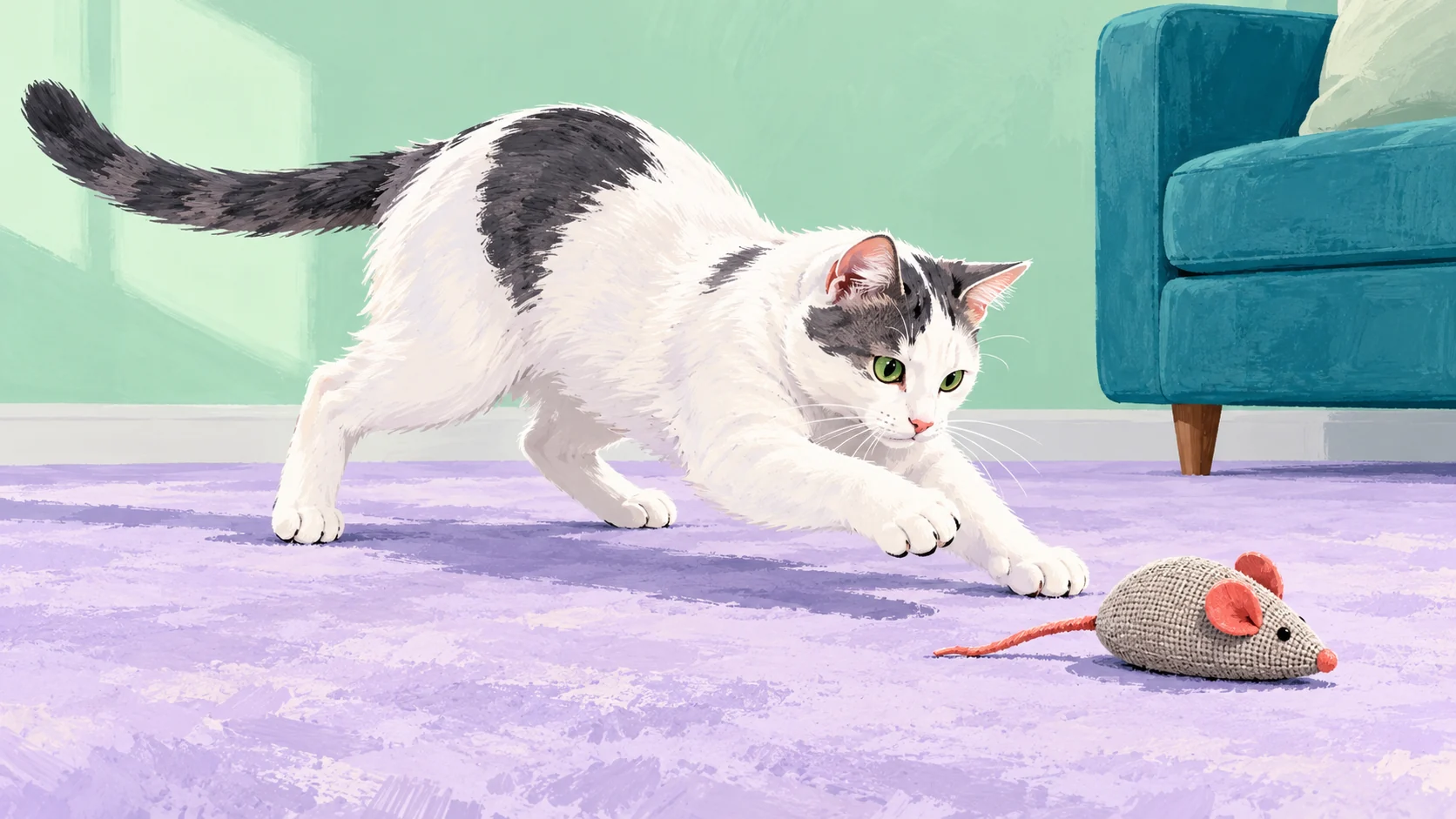
You bought a fabric mouse, placed it on the floor and waited. Your cat gave it the attention usually reserved for an unnecessary meeting invitation. Before concluding that your cat does not play, try a different question: is the toy simply there, or are you offering a game?
VCA explains that indoor cats benefit from physical exercise, mental stimulation and social interaction. It also stresses individual preferences. There is no universal toy, and enthusiasm is not an accessory supplied in the box.
You are part of the game
Notice what draws your cat's attention: a rolling object, a toy appearing beside a box or a short chase across the floor. The aim is to offer an opportunity, not turn the living room into a compulsory fitness class.
Cats Protection recommends making play a regular part of each day, particularly for indoor-only cats. Choose a routine you can repeat and adapt it to your cat's response. An impressive schedule is not much use if neither participant wants to show up.
Your fingers are not the mouse
Cats Protection advises against encouraging cats to hunt hands or feet. It recommends toys that keep play away from your body. The charm of a tiny predator wears thin when your ankle becomes downloadable content.
If you use a wand toy, take part and put it away afterwards. The charity warns that cats can become tangled in string toys. A fabric mouse offers a different possibility; observe how your cat uses it rather than assuming every accessory is suitable.
Curiosity is not a performance review
VCA suggests providing opportunities to explore alongside places to rest. Our starting point would be one small adjustment rather than a shopping list: clear a corner for play, change which toy you bring out or vary how you move it.
A cat that watches before joining in has not necessarily failed the activity. Equally, no single game should be advertised as a solution to every behaviour. If activity changes suddenly or the cat seems painful or unwell, speak to your vet rather than pushing on.
A home with something to do
For a household in Singapore or elsewhere, the useful starting point is the space you actually share, not an imaginary room from a catalogue. Look for a manageable place to interact and learn what your cat responds to.
The goal is not to exhaust an inconvenient housemate. It is to make room for interest and shared activity.
That mouse probably does not need Bluetooth. It may just need a second player.